


I felt like I was doing everything right early on in college, but my bench was going nowhere.
I spent months performing high-volume sets prescribed in a cookie-cutter program published by Bodybuilding.com called “Arnold Schwarzenegger Blueprint Ultimate Cuts Training Guide.” Then I got suckered into following the “Blueprint to Mass” program that followed that.
I benched at least two times each week and smoked my chest with every accessory lift, but my bench was still stalled.
After a master’s degree in Sports Performance and 10 years of training athletes, I’ve found the issue most men face isn’t a strength issue that’s keeping them stuck.
They simply can’t diagnose their body’s weak link or know how to attack it properly.
By the end of this article, you’ll know exactly what’s holding your bench back, how to target your weak links directly, and the exact programming I use with every athlete I train to build a big bench worth bragging about.

Identifying Your Weak Links
If you feel like you’re constantly spinning your wheels, here’s why:
A 2016 study in the Journal of Human Kinetics confirmed what I see in the weight room every day. Sticking points in the bench press are consistent and individual. This means where the bar dies on your lift is a reliable indicator of which muscle is holding you back.
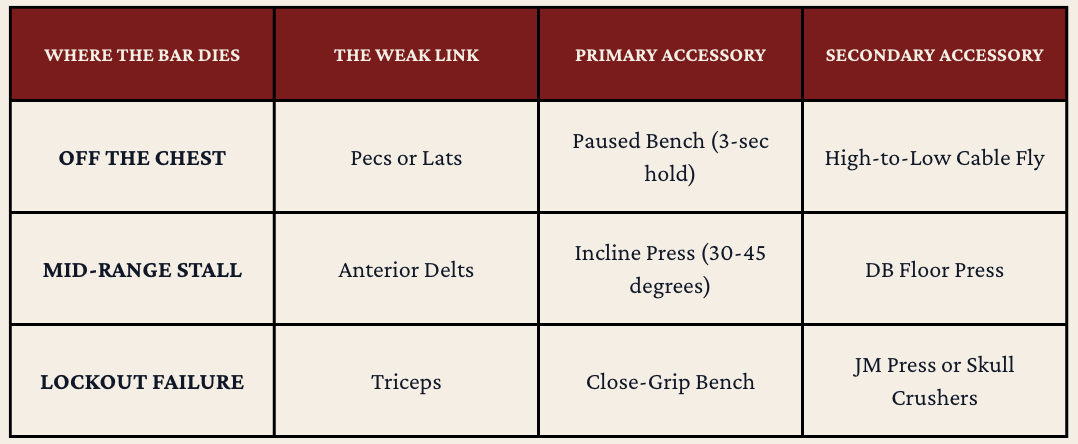
Every stalled bench press comes from one of three places: the bottom of the lift, a mid-range sticking point, or lockout failure.
If you struggle to get the bar off your chest, it’s caused by pec weakness, lat weakness, or poor leg drive.
If there’s a sticking point halfway through your lift that you can’t overcome, you’ve either got weak anterior (front) delts or your bar path sucks.
But if you’re struggling to lock out the rep all the way, you’re dealing with weak triceps or your elbows are flaring out.
Instead of building up your weakness, you’ve been working around it.
The next time you bench, pay attention to where the bar stops on your last rep. Where the bar dies is what you need to train.
Attack Your Weak Links Directly
I have an athlete that I currently work with that’s a total manchild meathead that means well. He’ll grab weight that he can handle for half of the prescribed reps and think it’s going to help him get stronger.
He had been stuck at a 295lb bench PR for six months. He thought his Instagram guru’s knew better, listened to his advice, and burnt out.
Here’s what happened when he followed my instruction:
After 8 weeks of training the eccentric and isometric portions of the lift, he began to see his progress in his bench press again.
He hit 300lbs for the first time ever, and even jumped up to 305lbs.
The answer to improving your bench press isn’t in performing more reps of bench press, but to attack your weak links in the movement.
The key to attacking your weak links is choosing the proper accessory movements for your issue. But there’s two important concepts you need to keep in mind when it comes to your accessory movements.
Your accessory lifts are not meant to be viewed as finishers. Accessory lifts are the medicine that treats your bench issue. They should be the priority of your training.
Secondly, you need to drop your ego.
The weight you use for your accessory movements shouldn’t be a PR every single day. They’re going to be lighter so you can work through your weak points in a full range of motion.
And if you’re sitting there saying, “I don’t have time for a 2-hour workout,” this isn’t that.
What I have for you doesn’t add sessions to your busy week. It replaces bad volume with targeted attacks on your weak links.
Here’s some examples:
The Exact Training Template
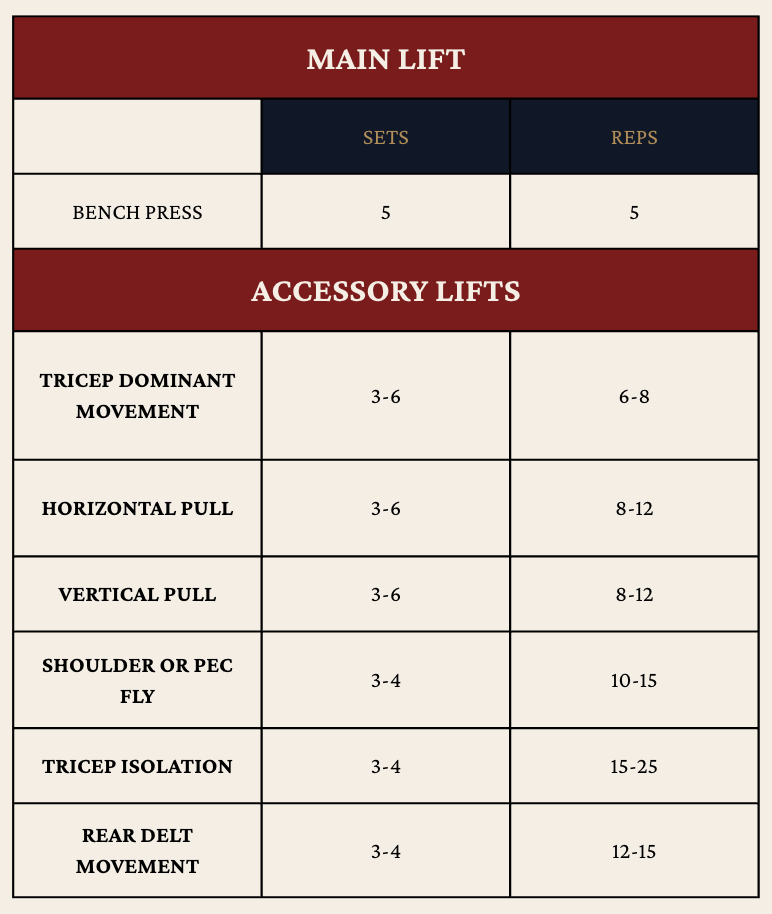
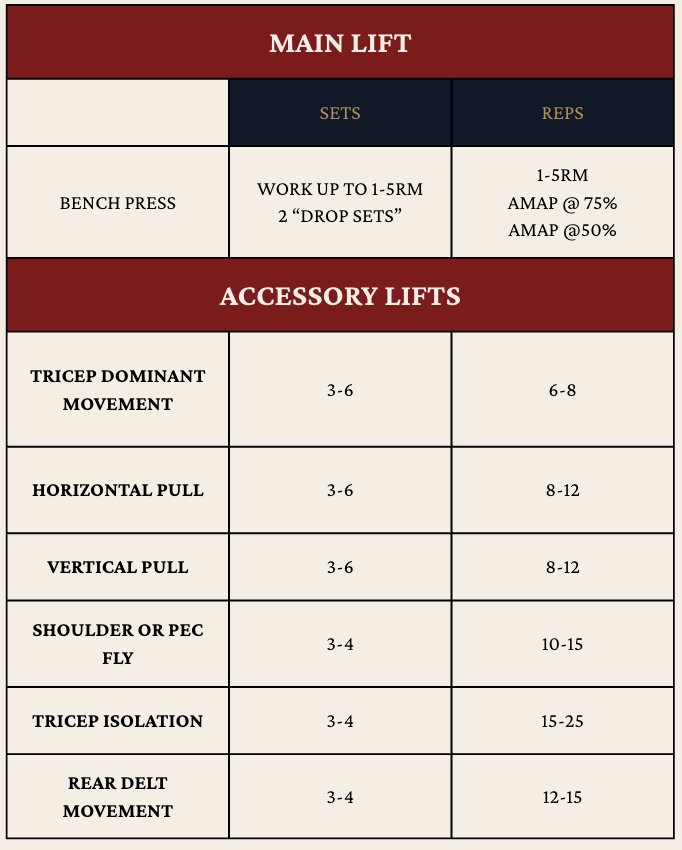
You’ll program two upper body sessions each week: one light day and one heavy day.
To keep things simple you’ll use a normal barbell bench press as your main lift each session and operate based on 3-week waves. Light days will progress 75% to 80% to 85%. Heavy days will progress 5RM (5 rep max) to 4RM to 3RM.
You’ll be able to adjust your accessory lifts based on your weakness and control your volume by adjusting the number of sets, reps, or weight used for the lift. Ideally you rotate accessory exercises every 3 weeks.
Here’s what each day will look like:
Light Day
Heavy Day
Start Your Path to Powerhouse
You’ve been in the weight room grinding, and putting in the work. You deserve a program built around what your body needs, and not another cookie-cutter plan designed for a 22-year-old with six free hours and nothing to lose.
The 6-Week Bench Buster gives you the exact structure, the right accessories for your weak link, and a week-by-week plan you can run in the time you already have. Get it below.
And if you want this kind of targeted, no-fluff training intel delivered to your inbox every week, join my newsletter: Path to Powerhouse.
It’s where I break training down for men who’re serious about getting back into his best shape without wasting a single hour of their gym time.
Grow stronger,
- Josh
This was helpful. I think my sticking point is midway, so now I know what to do!
😮💨😮💨😮💨amazing