


4:15 AM. I’m staring at 275 pounds on the barbell.
Four hours of broken sleep. My one-year-old screaming at 11:30, 1:00, and 2:45. A full day of coaching 150+ athletes ahead of me.
Every part of me wants to walk back inside, crawl into bed, and skip this.
The voice in my head is loud:
“You deserve rest. One day won’t matter. Train tomorrow.”
I know what happens if I listen. Tomorrow becomes next week. Next week becomes next month. Momentum dies. I’m back where I started.
So I lie down under the bar and start benching.
Not because I feel motivated. Not because I’m inspired.
Because I made a commitment to myself, and I refuse to break it over some lost sleep.
This is the real battle. The weight is just the tool. The war is in your mind.
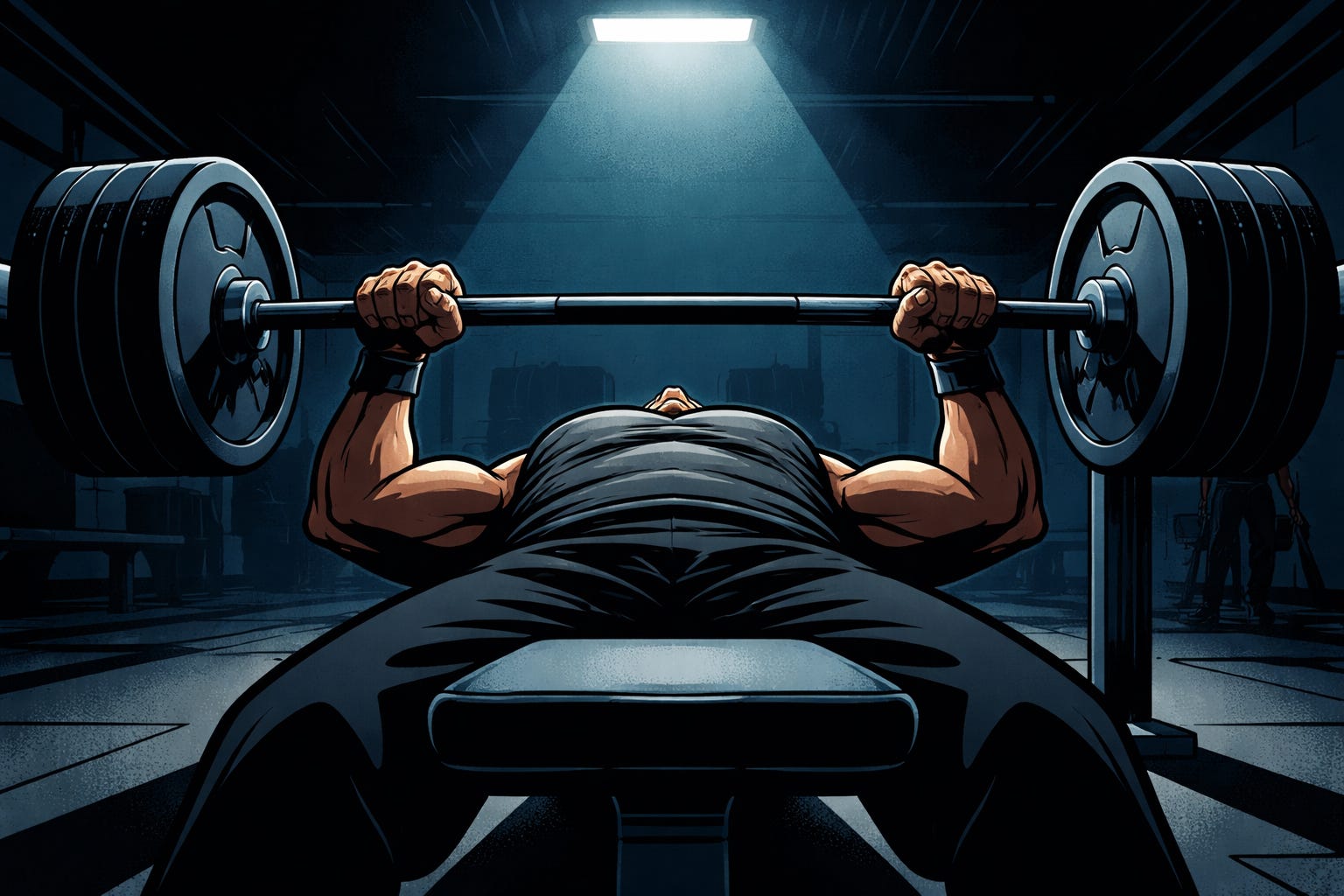
The Weight Room Is a Laboratory for Life
I’m not supposed to be where I’m at in life.
I was told the world of strength and conditioning was too difficult to break into for somebody that wasn’t a college athlete. I was told there’s no way my former high school would have anybody other than the head football coach running the weight room as their strength and conditioning coach. I was told my personality wasn’t suitable for leading a group of individuals.
But here I am:
Former D1 graduate assistant strength and conditioning coach. Strength and conditioning coach at my former high school. Offensive coordinator of a football program that has gone 96-24 over 10 seasons. Happily married to the most amazing woman on the planet. Three incredibly smart and charismatic kids.
All because of the lessons learned from the weight room.
You see, when you’re squatting heavy weight at 4:30 in the morning despite being woken up by a mouth-breathing two-year-old, and your legs are screaming at you to stop after your fourth set, you’re proving to yourself that you can complete hard tasks when conditions aren’t perfect.
When you stay consistent with this practice, you’re not just showing that you trust the process. You start building the long-term thinking that sets you up for that next step in life.
The weight room has never been just about muscles and heavy weights. It’s about building the skills that will continue to show up in your work, relationships, and your ability to handle stress when faced with adversity.
You’re not just building your physique when you show up to the gym. You’re forging the character of the man you want to be.
Let me show you why mindset is where most men fail, and the mental framework that actually works.
The Day I Almost Quit Everything
Last spring I almost gave up on coaching and working out altogether.
My wife and I just had our third kid. I was pissed off about decisions being made at the high school and how my coworkers were behaving. I was struggling to regain strength after taking time off to recover from a torn bicep.
I was over all of it.
I applied to nursing school. Took a microbiology course and lab online to get accepted. I told everyone I was leaving coaching and turned in my letter of resignation.
Then something happened.
One of the younger coaches at the school pulled me aside. A guy I’d been mentoring since he was 19. He looked me in the eye and said:
“You’re too good at this to walk away. We need you.”
Around the same time, we hired a new head football coach. Our former defensive coordinator. He called me and said:
“Can you give me a year? Help me rebuild this culture.”
I sat with that for a day and discussed it with my wife.
And I realized: I was quitting because things were hard right now. Not because coaching was wrong for me. Not because I didn’t love it.
Because it was hard.
The school welcomed me back. No questions asked. I withdrew my resignation.
That moment changed everything. I stopped seeing temporary struggles as permanent problems. I started thinking long-term.
Things may suck now, but it’s only temporary. Better things are ahead.
Here’s what I learned:
The battle isn’t physical. It’s mental.
Most men quit because they’re waiting to feel like continuing. They think motivation comes first, then action.
It’s the opposite. Action creates motivation. Discipline creates consistency.
Here’s the mental war you’re fighting every single day and how to win it.
The Mental Battles You’re Losing
BATTLE 1: COMPARING YOURSELF TO YOUR YOUNGER SELF
This one kills me more than any other.
At 24, fresh off my master’s degree, I could bench 350, squat 510, and deadlift 550 at 235 pounds. I was stronger, faster, leaner. No kids, no responsibilities. I could eat like a moron and recover overnight.
At 34, I’m coming off a torn bicep. I can bench 300, squat 405, deadlift 485. I have 3 kids under 6. I’m fighting to shed a dad bod, and my recovery moves at sloth speed some days.
That’s a 50-85 pound drop per lift.
I’m honestly pissed at myself for letting myself become weaker. I’m naturally competitive, so I want to be as strong and lean as possible.
But here’s what that voice in my head says:
“You’re never going to be who you were in your twenties. Why keep trying?”
Sometimes it leads to subpar training. Other times it gives “validity” to excuses that begin to pop up in my mind, and surrender begins to look welcoming.
The truth? I’m not 24 anymore. And I never will be again.
But I can be the strongest, most capable 34-year-old version of myself. And at 44, I’ll be the strongest version of that guy.
Comparing yourself to your younger self is a losing game. Compare yourself to who you were yesterday.
BATTLE 2: THE “ALL OR NOTHING” TRAP
You just had the perfect week. You killed every single one of your sessions, and you managed to eat all of your meals. But then you hit a speed bump on Saturday.
You slept in and missed your workout. Then you had to go through the drive-thru between your kids’ swimming lesson and basketball games. To top it off, you had too many beers with the boys while watching the game.
You wake up on Sunday feeling like a failure. You start thinking you should just start over on Monday and end up spiraling until Wednesday.
This behavior leaves you constantly restarting instead of progressing.
The fix: One bad day doesn’t erase six good ones. Train Sunday morning. Get back on track. Monday isn’t magic.
BATTLE 3: THE VOICE THAT SAYS “SKIP IT”
Your alarm goes off every morning between 3:45 AM and 4:15 AM. You’re tired. You might’ve had a long day yesterday. The voice in the back of your mind is going to say:
“One day won’t matter. You can always train tomorrow. You deserve to rest.”
When you listen to this voice, tomorrow’s training gets pushed to next week. Then pushed back again to next month. Your inconsistency kills any progress before it even starts.
The fix: Stop negotiating. The decision was made last night when you set your alarm. You’re not asking “Should I train today?” You’re asking “What time am I training?”
BATTLE 4: QUITTING WHEN IT GETS HARD
You take a look at today’s workout and see that it calls for 4 sets of heavy squats. Set 1 goes alright. Set 2 gets difficult. Set 3 pushes you to the point of quitting.
You tell yourself that’s enough for the day, and you worked hard enough. Nobody will ever know that you skipped the 4th set. This becomes your regular habit.
Because of this, you never learn to push yourself past your comfort zone. You never grow, and you never achieve your goal of being able to lead with confidence because you know you’ll quit when things get hard.
The fix: The 4th set is where you grow. Do one more rep when your brain says stop. Then do another. That’s your growth rep.
THE REAL PROBLEM
Your body isn’t the issue. Your mind is.
You don’t need more motivation, to “feel like it,” or better conditions to pursue becoming a mental powerhouse.
What you need is discipline. To shut up, do the job, and perform under pressure.
Mental toughness isn’t something you’re born with. It’s something you develop one difficult rep at a time.
Here’s the framework.
The 5 Mental Principles of the Path to Powerhouse
PRINCIPLE 1: SHIFT IDENTITY FROM “I WORK OUT” TO “I’M AN ATHLETE”
The identity you assume dictates the actions you take. There’s no denying it. If you see yourself as the guy that works out from time to time, you’re going to act that way. But once you start seeing yourself as an athlete, your behavior changes instantly.
Ask yourself these questions:
Does an athlete skip training because he’s tired?
Does an athlete quit early in sets because they’re hard?
Does an athlete binge on the weekends and blow his progress?
Does an athlete show up, do the work, and trust the process?
When I started thinking of myself as an athlete again, instead of “a dad who lifts,” everything changed.
Before the identity shift (Dad who lifts):
I trained maybe 3 days per week
I would skip if either kid woke up during the night, telling myself I needed to rest
I negotiated with myself every morning: “Do I really need to train today?”
After the identity shift (Athlete):
I train 5 days per week and never skip
I make sure I get 10K+ steps each day and record some form of lift or cardio session
I stopped allowing how I felt to dictate how I lived
The question isn’t “Should I train?” It’s “What time am I training?”
The identity shift removed the decision. Athletes train. That’s what they do.
Here’s how you can make the shift:
Stop saying “I’m trying to work out more.”
Start saying, “I am an athlete that trains.”
Make decisions from the viewpoint of this new identity.
You won’t rise to the level of your goals. You’ll only fall to the level of your identity.
Choose wisely.
PRINCIPLE 2: DISCIPLINE > MOTIVATION
We’ve all heard it before: motivation is a feeling that comes and goes. But discipline? Discipline is a constant decision to be consistent regardless of how you feel. Waiting to “feel motivated” means you’ll never be consistent.
I’ll be real. Motivation gets you started on your journey and will make a return once you start seeing the results you’re longing for. But discipline is what keeps you going during that time when the results are slow or nonexistent.
You won’t feel motivated most days. You’ll be tired, stressed, sore, busy, and distracted.
But if you only train when you feel like it, you’ll end up training 2-3 days the entire month, and that’s only enough to build resentment for yourself.
Here’s the paradox most men miss:
Motivation follows action. Not the other way around.
You think: “I’ll train when I feel motivated.”
Reality: You feel motivated AFTER you start training.
I’ve never regretted a workout. I’ve regretted skipping plenty.
The first 5 minutes suck. Your body resists. Your mind makes excuses.
Then you finish the warm-up. You load the bar. You hit the first set.
Suddenly you feel alive. Focused. Strong.
That’s not motivation. That’s discipline creating the conditions for motivation to show up.
Stop waiting to feel like it. Start moving. The feeling follows.
Here’s how to build discipline:
Remove the decision by planning and establishing your training and nutrition ahead of time. There’s no negotiating it. You train when scheduled and eat what’s planned.
Start with a 30-minute session and three easy-to-cook meals. You can’t fix everything all at once. You have to build up to it.
Track your streak on the calendar and reward yourself with new gym gear for different milestones.
Disciplined action will compound over time. Every time you do something you don’t feel like, you’ll fortify your mind, making it easier to do things when you don’t feel like it.
PRINCIPLE 3: GROWTH LIVES OUTSIDE YOUR COMFORT ZONE
Your body is designed to adapt to stress, so when there’s no stress, there’s no adaptation. The sets that hurt the most, make you shake, make you want to throw up, and make you nearly pass out are where growth happens. If every workout you did felt comfortable, you’d be building nothing.
Unfortunately, most men train in their comfort zone. They train with weights they can handle instead of pushing the envelope. They stop sets when it starts to burn instead of finishing as directed. Worst of all, they completely avoid exercises that expose their weakness. Then they wonder why they’re not getting stronger.
If you want to embrace discomfort, start here:
Seek out the hard sets, because you aren’t growing if they aren’t challenging you.
Do one more rep when your brain is telling you to stop. Then do another.
Attack your weaknesses. They aren’t going to disappear on their own.
Reframe the burning in your muscle as your body adapting. Learn to love it.
You have to become comfortable with being uncomfortable. The guy who always runs away from the hard sets will always stay weak. But the guy who digs in and conquers the difficult sets is the one that gets strong.
Which one are you going to be?
PRINCIPLE 4: THE PROCESS IS GREATER THAN THE OUTCOME
No matter how hard you try, you can’t control how much muscle you gain or how fast your strength increases. But you can control showing up, completing sets with relentless intent, hitting your protein target, and getting enough sleep to recover. When you focus on what you can control, the results will take care of themselves.
The problem is that most men focus only on the outcomes. They want their results, and they want them as fast as possible with as little friction as possible. Who can blame them?
But they end up checking the mirror daily, weighing themselves obsessively, getting frustrated with slow results, and quitting before momentum starts to compound.
Instead, they should ask these daily questions:
Did I train today?
Did I hit my protein target?
Did I get 7+ hours of sleep?
Did I complete all my working sets with relentless intent?
If you complete these actions daily, results are inevitable. You just won’t be able to predict when.
Here’s how to implement:
Define your 3-4 daily non-negotiables. Mine are training, eating protein, 10K+ steps, and water intake.
Use a checklist to track your actions instead of the outcomes.
Trust the process. A consistent process guarantees results.
You can’t control when you’ll gain 20lbs. You can control whether you squat today. Do that 100 times and the 20lbs shows up.
PRINCIPLE 5: LONG-TERM VS. SHORT-TERM THINKING
Quick fixes will always fail because they’re unsustainable. You have to remember that your health and fitness is a marathon, not a race. Your goal isn’t to get in shape, but to stay in shape for decades so you have energy to play with your kids and grandkids. What you’re doing now is building the body that you’ll have in your 40s, 50s, 60s, and 70s.
I see it all the time. Most men go hard for 8-12 weeks following a popular challenge or training plan. They do all the work just to burn out, get injured, or lose their motivation altogether. They quit, lose progress, and start over 6 months later. The cycle repeats forever with nothing ever accomplished.
But you’re not just training for this summer. You’re training for every summer after that.
Train hard, but not hard enough to burn yourself out.
Set realistic expectations of building 1-2lbs of muscle per month, not per week.
Understand that rest days are part of the plan and schedule them strategically.
Make sure that training fits your life, but doesn’t consume it.
If you can’t do something consistently for 10 years straight, it’s time to re-evaluate.
The Transfer to Life
As you build mental toughness in the gym, you’ll begin to see it spill into every other area of your life.
Here’s how this is showing up for me right now.
I’m currently trying to build Path to Powerhouse into a real business that can one day replace my job if something were to ever happen at the school. But I’m doing that while working a full-time job, coaching football, being a great dad and husband, and trying to take care of and fix up the house.
I want to obsessively attack the building of the business because I know it can take off with a year of focus.
Old me would’ve given up when things get overwhelming, like this last week with water softener problems and emergency room bills on top of getting the house ready for my oldest son’s birthday party.
The new me is rolling with the punches, taking advantage of free time when I get it, and controlling what I can control.
I’m still here. I’m still building. And I have no plan of stopping.
That composure didn’t come from a motivational speech. It came from thousands of mornings of training when I didn’t feel like it.
The gym taught me how to perform under pressure. Everything else is just application.
Now here’s how this shows up in your life:
When you’re facing a difficult project at work with a tight deadline, instead of caving to the voice that says, “This is too hard. I can’t do this,” you’ll push through because you’ve trained your mind to do hard things.
When it’s 7 PM and your 5-year-old wants you to run around the front yard, the voice will say you’re too tired. But you’ll have trained your mind to show up when you don’t feel like it.
When your spouse wants to have a tough conversation, you won’t run from it. You’ll embrace it head-on because you’ve trained to embrace discomfort.
And when work is chaotic, finances are tight, and life feels overwhelming, you’ll stay calm under pressure because you’ve built resilience in the gym.
When you build discipline, resilience, and mental toughness in your training, you become the kind of man who can handle whatever life throws at him.
The Honest Truth
I’m not going to sit here and lie to you. This will be hard.
There are going to be days you don’t want to train, days where progress feels slow, and days you question if it’s even worth it.
You’ll have weeks where life gets chaotic with sick kids, work deadlines, travel, and stress. You’ll feel your consistency slip.
You’ll hit plateaus where your lifts stall and wonder if you’ve hit your peak.
Trust me, this is all normal. It happens to everyone, including me.
Last month I came home sick after lunch with intense stomach cramps and diarrhea. Ended up vomiting everything out and losing 10 pounds. Within a week all three kids had the same stomach bug. I got it again towards the end of their sickness. My wife got sick the next week, and I got it a third time after that.
When I was healthy, I trained at least 30 minutes. When I was sick, I at least tried to get my 10K steps.
The only thing that kept me going was my desire to be the best I can be. I knew all I had to do was something to keep the momentum rolling.
The difference between men who transform and men who quit isn’t that one group has an easier life. It’s that one group keeps going even when they don’t feel like it.
So you’ve got two paths you could follow:
Path 1: Keep waiting for perfect conditions, motivation, and an easier life. Never start, and stay where you are.
Path 2: Accept that life’s hard and train anyway. Build discipline one rep at a time and become a new version of yourself.
Which path are you taking?
Your Next Step
You now have the complete mental framework: identity shift, discipline over motivation, embrace discomfort, process over outcome, long-term thinking.
But mental toughness isn’t built by reading about it. It’s built by doing hard things when you don’t feel like it.
I created the Path to Powerhouse 7-Day Kickstart to give you a proving ground.
What’s inside:
3 full-body training sessions (train even when you don’t feel like it)
Daily mindset prompts (build discipline one day at a time)
Completion checklist (prove you can finish what you start)
Simple nutrition framework (stop overthinking, start executing)
This is your test.
Can you show up for 7 days straight? Can you train when you’re tired? Can you hit your protein target when it’s inconvenient? Can you finish what you start?
Most men can’t.
Prove you’re not most men.
Download the 7-Day Kickstart and start tomorrow.
Grow stronger,
- Josh