


Bryan Johnson and Gary Brecka posted about alcohol within hours of each other this week. Neither one was lecturing, but both were pointing at the same three mechanisms.
When the two highest-signal voices in longevity align on the same specific claim in the same week, that’s worth understanding.
Because most men who train seriously already know alcohol isn’t ideal. What they don’t know is the reason why.
I’m a strength and conditioning coach with a master’s degree in sports performance. I’ve spent the last decade training high school athletes to elite standards: 300lb+ cleans, 500lb+ squats, and sub-4.6 forties. Recovery isn’t a soft topic in my program. It’s the variable that separates the athletes who make it from the ones who don’t.
In this article, I’ll explain the three mechanisms alcohol pulls simultaneously, why it’s important, and why drinking zero alcohol is a much better performance standard than drinking in moderation.
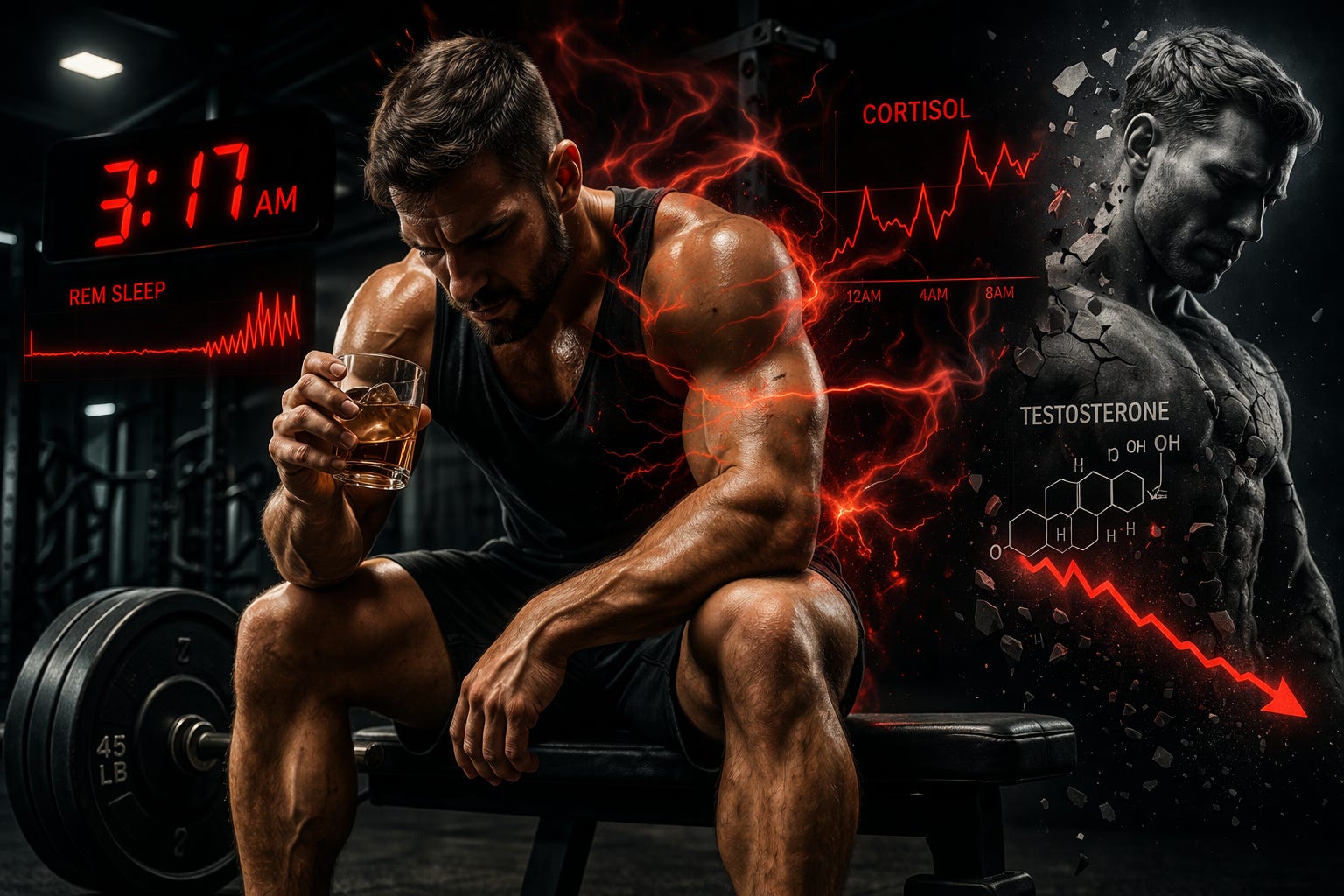
Lever 1: REM Architecture
Most men know alcohol disrupts sleep. What they don’t know is which part.
Sleep isn’t as simple as closing your eyes and waking up the next morning. It cycles through stages: light sleep, deep slow-wave sleep, and REM. Each stage does different work.
Deep slow-wave sleep is where your body handles physical restoration like tissue repair, cellular cleanup, and growth hormone release.
REM is when your nervous system handles everything else. This period is where your memories are consolidated, emotions are regulated, and hormones are signaled to tell the body how to adapt to the training stress you put on it.
Alcohol is a sedative that makes you fall asleep faster. It actually suppresses REM in the first half of the night, stopping your brain from doing its most productive recovery work. As the alcohol metabolizes, REM tries to catch up in the second half of the night but is fragmented.
Instead of sleeping through the night, you’re sedated through the first half and poorly resting the second half.
You wake up sweaty in a cold room, feeling like crap.
For a man training four days each week, every night he drinks is a night his nervous system isn’t adapting to the load he puts on it.
He completed the work, but the adaptation didn’t happen.
And the research isn’t talking about binge drinking. Studies show REM suppression with two standard drinks for a 180-pound man.
Lever 2: Cortisol Timing
Cortisol has received a bad reputation. Morning cortisol is what wakes you up, sharpens your focus, and prepares your body to function.
The problem is cortisol hitting at the wrong time.
In a healthy man, cortisol follows a diurnal rhythm. It’s high in the morning, and low at night. That nighttime drop is what allows your body to shift into repair mode resolving the inflammation from training and tilting your hormonal environment toward building muscle instead of breaking it down.
Alcohol breaks that rhythm.
As your body works to metabolize it through the night, cortisol spikes during the second half of your sleep when it should be at its lowest. Your body spends the night in a low-grade stress state instead of recovering. The inflammation hangs around and your anabolic window shrinks.
Let me put this in perspective with an example from my mid-20s.
I’d enjoy a couple of shots of whisky every Friday night to celebrate the end of the week. Saturday morning I’d wake and head to the gym for my bicep, tricep, and shoulder workout. Never once once did I feel hungover or impaired from the night before.
Every Saturday morning, that session felt like I was trying to move boulders with twigs. I chalked this up to a long week, not getting enough sleep because of a late bedtime, or the pizza I had for my cheat meal.
I was right about the sleep, but wrong about the cause.
The cortisol spike from the two drinks on Friday night drifted into Saturday afternoon. This wasn’t a small thing for me as a man trying to build strength on a schedule with limited recovery time. That creates a margin between productivity and a plateau that you can’t explain.
A hangover was never the cost, but the cortisol disruption was. Unlike the hangover, I could never feel it.
Lever 3: Testosterone Production Windows
Testosterone is produced in pulses throughout the night, with the largest pulse happening during your deep sleep in the early morning. What happens during that window determines your baseline testosterone.
Alcohol suppresses this production in two ways.
First, it directly inhibits the cells responsible for producing testosterone in proportion to blood alcohol levels. Second, alcohol elevates estradiol, signalling your pituitary to reduce the hormone that triggers testosterone production.
Sounds like a bad deal.
However, testosterone levels typically recover within 24-48 hours after a moderate drinking episode for a healthy young man. Keep it mind that it’s still 24-48 hours of reduced testosterone while your body is trying to adapt to training stress.
This is even more of a nightmare for men in their 30s and 40s whose testosterone is already naturally trending downward. Here’s why age affects everything.
Most of the research on alcohol and testosterone is conducted on men in their 20s with high hormonal baselines. A 22-year-old at 700 ng/dL absorbs a temporary suppression differently than a 42-year-old at 450 ng/dL.
Let me be clear:
The moderate drinking guidelines designed for younger men do not apply to the men this article is written for. The cost is higher, the recovery is slower, and the compounding effect across the full training year is significant enough to inhibit your results.
Why All Three Levers Matter
This model isn’t important because of any single lever. It’s that alcohol pulls all three at the same time, every time, and the effects don’t reset until Monday.
Two drinks Friday night. REM’s suppressed, cortisol spikes Saturday morning when it should be at zero, and testosterone production is interrupted during the exact window your body needed it most.
Saturday’s training session feels harder than it should. You’re not fully recovered from Thursday. You don’t know why, but you blame the long week.
Sunday you feel fine, but you’re far from fine. You’re running a deficit that shows up Tuesday as weights that won’t move, progress stalling for no reason, and a deload you shouldn’t need yet.
This is why the men who eliminate alcohol don’t describe it as a sacrifice. They describe it as the variable that finally made everything else work.
Your supplement stack, sleep protocol, and training program are crap as soon as you bring alcohol into the equation. So don’t blame your protocols, blame the alcohol.
Why Zero is Replacing Moderation
Moderation has been the accepted position in fitness for over 20 years. It’s kept coaches relatable and the conversation comfortable. I get it. It’s a tough conversation to have with your clients.
But the research Johnson and Brecka allude to makes it clear that moderation isn’t a performance standard.
It’s a compromise.
Because no dose of alcohol deactivates the three levers. Every drink moves all three levers in the wrong direction. Moderation only dictates how far.
Zero shouldn’t be an extreme position if you’re serious about taking care of your body. It’s the same standard serious athletes apply to their training load, sleep, and nutrition.
That’s why I built the Path to Powerhouse newsletter.
Every week, paid subscribers will receive deep dives like this one delivered to their inbox and have access to monthly training modules that I’ve used with the athletes I’ve trained.
If you’re looking for strength, now’s the time to act
Grow stronger,
- Josh
I gave up alcohol forever in 2024. No regrets and no looking back. It's just not worth it. Too many negative side effects. No real positive benefits (I can still enjoy all the social aspects while simply not drinking, even if everyone else drinks). Alcohol just doesn't align with what I want from my life. Plus, never drinking saves money.