


Keto. Carnivore. Intermittent fasting. Carb cycling. Macro tracking. Meal timing. Supplements.
I’ve been coaching athletes for over a decade, and I’ve watched every diet trend sweep through and disappear.
Every influencer swears their protocol is the only “science-based” approach. They all claim to have the secret.
Meanwhile, you’re standing at your kitchen counter at 6 AM before work, trying to figure out what the hell to eat that will actually help you build muscle without spending all Sunday meal prepping.
You just want to know:
What should I eat to get stronger, build muscle, and not feel like garbage?
Here’s the truth: Nutrition for performance is simpler than the diet industry wants you to believe.
Let me show you why common nutrition advice fails busy men, and the 5 simple principles that actually work.
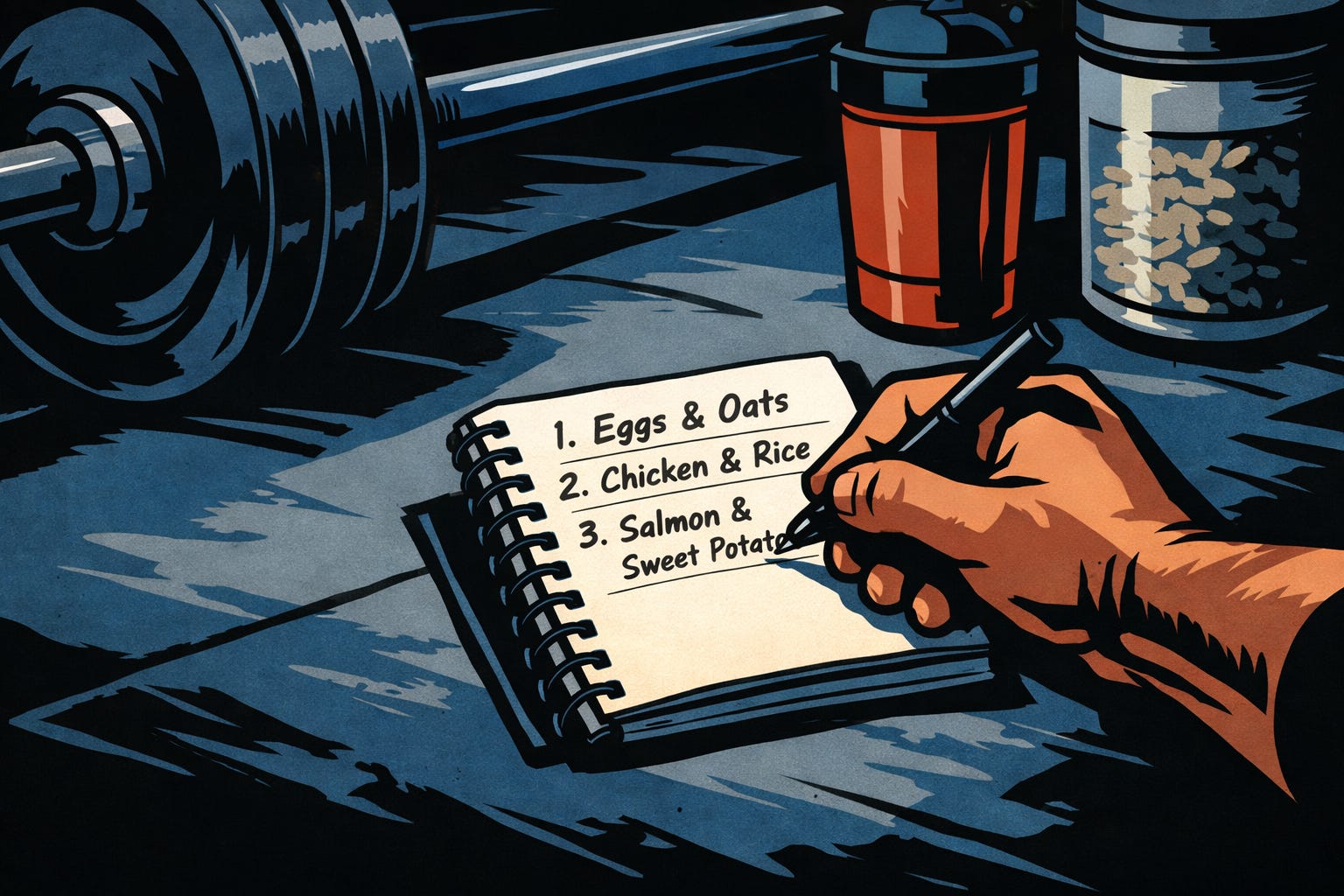
Why Nutrition Advice Fails Busy Men
The Diet Industry Sells Complexity
Every influencer needs to have their own “unique system” to help them stand out from the crowd so they can sell their courses and programs. Everywhere you look you’ll find influencers fighting that keto, carnivore, paleo, vegan, and “if it fits your macros” are all the secret we’ve been looking for.
Do they work? Sure, but only because they are based on the same fundamental principle of eating fewer calories than you burn. The complexity the industry created keeps you buying books, programs, and supplements instead of just eating real food. You’re so overwhelmed by conflicting opinions that you end up doing nothing.
Most Nutrition Advice Is for Fat Loss, Not Muscle Building
90% of the content you’ll find online is for cutting, shredding, and getting lean. Very little content talks about eating to build strength, add muscle, and perform better. Busy men don’t need another fat loss protocol. They need to fuel performance. You can’t starve your way to the physique you want.
You Don’t Have Time for Bodybuilder-Level Meal Prep
Every Sunday, you’re spending hours prepping 42 meals for the week. You weigh every ounce of chicken and every gram of rice. You measure out your vegetables perfectly. Then you have to turn around and cook separate meals for your family throughout the week.
This isn’t sustainable for a guy working 50+ hours, juggling family obligations to wife and kids, and every other responsibility he has on his plate. Busy guys need a simple system that allows them to hit their goals even when life gets messy. You stay consistent Monday through Friday, then fall apart on weekends because you have no simple framework to follow.
At the end of the day, here’s what matters:
Eat like an athlete, fuel your performance, and keep it simple.
What Does “Eat Like an Athlete” Mean?
Athletes eat to fuel their training, recover from exercise faster, and build strength. They prioritize protein for muscle repair and growth. Athletes don’t fear carbs like the keto crowd does. They eat enough to train hard. They also aren’t obsessing over meal timing or supplements because they eat consistently with no extreme restrictions.
Why This Works for Busy Men
Eating like an athlete provides simple rules that you can follow anywhere, and there’s no meal prep marathons required. You can be flexible enough to eat with your family and this can be sustainable for the long-term. You’ll be able to see the difference because your lifts will go up and you’ll be building muscle.
The Difference
Diet culture says: Eat as little as possible, fear carbs, obsess over meal timing, suffer through hunger, hate food.
Eating like an athlete says: Eat enough to fuel performance, use carbs strategically, hit your daily totals, enjoy food, build muscle.
One approach makes you miserable and weak. The other makes you strong and capable.
Choose wisely.
So what does this actually look like? Here’s the framework.
The 5 Principles of Performance Nutrition
PRINCIPLE 1: PROTEIN FIRST
Protein is the foundation for muscle repair, recovery, and growth. You need 0.8-1g per pound of bodyweight. So if you weigh 200lbs, you would want to eat 160-200g of protein each day. This is a non-negotiable practice if you want to build muscle.
Why This Amount
Lower amounts of 0.5-0.6g per pound work great for maintenance, but not for growth. And there’s no extra benefits for most people when eating greater than 1.2g per pound. 0.8-1g per pound is the sweet spot backed by years of research.
How to Hit This Target
Eat 4-5 servings of protein per day that range from 30-50g. For example:
8oz chicken breast = ~50g
4 whole eggs = ~24g
1 scoop whey protein = ~25g
8oz Greek yogurt = ~20g
8oz steak = ~50g
Protein should be eaten at every meal. If you’re struggling to hit your target every day, consider a protein shake post-workout or before going to bed.
A common mistake that a lot of guys make is eating one big protein meal and wonder why they’re not building muscle. You need consistent protein intake across the day for optimal muscle protein synthesis.
PRINCIPLE 2: CARBS FUEL TRAINING
Carbs are your body’s preferred fuel for intense training sessions. Without adequate carbs, your workouts will suffer. You won’t feel as strong, won’t be able to handle as much volume, and you’ll have worse recovery. What most people don’t know is that the timing of your carb intake matters more than the total amount you eat.
When to Eat Carbs
Pre-Workout
Eat 40-80g of carbs 1-3 hours before your workout. These can come from sources like oats, rice, bread, and fruit. This is going to provide energy for your session and prevent mid-workout crashes.
Post-Workout
Eat 60-100g of carbs within 2 hours of completing your workout. These can come from rice, potatoes, pasta, and fruit. This is going to replenish your glycogen stores, support recovery, and support muscle growth.
Carb Sources
Rice (white or brown)
Potatoes (sweet or white)
Oats
Bread, pasta
Fruit (bananas, berries, apples)
What About Low-Carb?
What about it? Why would you want to handicap yourself? Carbs make training easier, recovery faster, and muscle growth more efficient. Unless you have a medical reason to avoid them, you should be eating carbs around your training.
Practical Example:
Pre-workout: Oatmeal with banana and honey (60g carbs)
Post-workout: Chicken, rice, and veggies (80g carbs)
That’s 140g carbs strategically placed around your training. Easy.
PRINCIPLE 3: DON’T FEAR FAT (BUT DON’T OVERDO IT)
Fat is essential for hormone production, including testosterone. Without it, your body would struggle to create enough testosterone to help you build muscle. So you need fat, you just don’t need it in massive amounts. Aim for 20-30% of your total calories from fat.
Fat Sources
Eggs (whole, not just whites)
Nuts and nut butters
Avocado
Olive oil and coconut oil
Fatty fish (salmon)
Grass-fed beef
The Balance
Fat is the most calorie-dense nutrient coming in at 9 calories per gram as opposed to the 4 calories per gram of protein and carbs. It’s easy to overeat fat and crowd out protein and carbs. You will be including it in your meals naturally by cooking with olive oil, eating eggs, and having nuts as a snack. But you don’t want to drench everything in butter thinking you’re getting “healthy fats.”
Common mistake: Keto bros eating 200g fat per day and wondering why they can’t build muscle or train hard. You need carbs to fuel performance. Fat has a role, but it’s not the star of the show.
PRINCIPLE 4: EAT ENOUGH TOTAL CALORIES (ESPECIALLY IF BUILDING MUSCLE)
You can’t build muscle while eating in a calorie deficit. Most busy guys undereat because they’re afraid of getting fat, leading to a perpetual semi-diet. But building muscle requires a slight calorie surplus of no more than 200-300 calories above maintenance.
How to Determine Your Needs
Maintenance Calories
Multiply your bodyweight by 14-16 depending on activity level. Inactive men multiply by 14, active men by 16. So a 200lb man will eat 2,800-3,200 calories each day to maintain weight.
Muscle Building Surplus
Add 200-300 calories to your maintenance total. Our 200lb man would then eat 3,000-3,400 calories each day.
Fat Loss (If Needed First)
Subtract 300-500 calories each day to create the deficit needed to lose fat. A 200lb man would then eat 2,400-2,800 calories each day.
Why This Matters
If you’re training hard, eating 180g protein, but only consuming 2,000 calories each day, you won’t build muscle. Your body needs energy to grow, so stop being afraid of food.
Practical Guidance
Start with maintenance calories for 2 weeks. If your weight stays stable, add 200-300 calories and continue to track your weight. If you’re gaining 0.5-1 pound each week and your lifts are going up, you’re on the right track.
PRINCIPLE 5: CONSISTENCY BEATS PERFECTION
Eating perfectly Monday through Friday and binging on the weekends leads to zero progress. Eating consistently for 6-7 days each week is when you’ll start to see real results because your body is going to respond to what you do consistently and not occasionally.
The 80/20 Rule
80% of your meals should be high protein, nutrient-dense whole foods. The other 20% can be whatever you like. Enjoy a pizza with your kids or a few beers with the boys. It doesn’t matter. This will help keep you sane and is sustainable for the long term.
Real Talk
I’ve seen guys obsess over meal timing, supplements, and organic vs. non-organic foods. Then they blow their nutrition every weekend. On the other hand, the guy eating grilled chicken and rice every day is the one making real progress. Guess who wins?
What This Looks Like in Practice
Flexibility
This isn’t a meal plan you follow robotically. Swap chicken for steak, rice for potatoes, salmon for ground beef. The principles stay the same: high protein, carbs around training, enough total calories.
Simplicity
Notice what’s NOT here: complicated recipes, exotic ingredients, Tupperware containers for 6 meals. This is how a busy man eats to build muscle with real food, simple preparation, and consistent execution.
Family-Friendly
Most of these meals work for the whole family. Your wife and kids can eat the same dinner. No separate meal prep required.
Sample Day for a 200lb Man Building Muscle (3,200 calories, 180g protein)
6:00 AM - Pre-Workout Meal
1 cup oats with banana, honey, cinnamon
1 scoop whey protein mixed in
Black coffee
Calories: 450 | Protein: 35g | Carbs: 70g | Fat: 8g
7:30 AM - Post-Workout Meal
4 whole eggs scrambled
2 slices whole grain toast with butter
1 cup berries
Calories: 550 | Protein: 30g | Carbs: 45g | Fat: 25g
12:00 PM - Lunch
8oz grilled chicken breast
1.5 cups white rice
Steamed broccoli with olive oil
Calories: 650 | Protein: 50g | Carbs: 70g | Fat: 15g
3:00 PM - Snack
Greek yogurt (8oz) with granola
Apple with 2 tbsp almond butter
Calories: 450 | Protein: 25g | Carbs: 50g | Fat: 18g
6:30 PM - Dinner
8oz salmon
Large sweet potato with butter
Mixed green salad with olive oil dressing
Calories: 700 | Protein: 45g | Carbs: 60g | Fat: 28g
9:00 PM - Evening Snack (Optional)
Protein shake with milk
Handful of mixed nuts
Calories: 400 | Protein: 30g | Carbs: 20g | Fat: 20g
Daily Totals:
Calories: ~3,200
Protein: 215g (1.07g per lb bodyweight)
Carbs: 315g
Fat: 114g
Common Nutrition Mistakes Busy Men Make
Mistake 1: Not Eating Enough Protein
They swear up and down that they’re eating enough, but when they actually take the time to track it, they’re only eating 100-120g each day. That’s good enough to maintain, but it won’t help you build.
Fix: Track for 3 days, then adjust as needed. Add a protein shake if you have to.
Mistake 2: Skipping Breakfast (Or Undereating Early in the Day)
Busy men usually have to rush out the door with their coffee and end up feeling like they’re starving by noon. Eating all of your calories in the second half of the day isn’t optimal for muscle growth.
Fix: Eat a real breakfast that has 30-50g of protein.
Mistake 3: Fearing Carbs
Years of low-carb diet culture has men terrified of rice and potatoes. Because of this, their training suffers and their recovery sucks. But they still want to blame “genetics.”
Fix: Eat 200-300g carbs each day, mostly around training. Watch your strength explode.
Mistake 4: Weekend Binges That Erase the Week
Many men are dialed in Monday through Friday and ruin their week with their 5,000 calorie weekends. Too much of a surplus leads to storing fat. Nobody will be able to see your progress underneath all the fat.
Fix: Allow yourself some flexibility, but stay reasonably consistent. Don’t go from 3,000 cal weekdays to 6,000 cal weekends.
Mistake 5: Chasing Supplements Instead of Fixing Diet
Men will buy hundreds of dollars worth of supplements but won’t eat 4 real meals a day. Newsflash: creatine and protein powder are the only supplements that matter. Everything else is marketing hype.
Fix: Nail the basics first (protein, carbs, calories, consistency). Then add supplements if needed.
Mistake 6: Overthinking Meal Timing
Total daily protein and calories matter far more than meal timing for busy men. Stop obsessing over eating exactly 30 minutes post-workout. Don’t worry about intermittent fasting windows. Just hit your numbers.
Fix: As long as you’re eating carbs within a few hours of training and hitting your daily protein target, you’re fine.
Mistake 7: Drinking Calories Without Realizing It
Starbucks frappuccinos, sugary coffee drinks, soda, juice, and alcohol add hundreds of calories without filling you up or providing nutrients.
Fix: Drink water, black coffee, or tea. Save liquid calories for protein shakes and milk (which serve a purpose). If you’re drinking 500+ calories per day in lattes and soda, that’s why you’re not seeing results.
Supplements That Actually Matter
Tier 1: Worth Taking
Creatine Monohydrate (5g/day)
Creatine is the most researched supplement in history, and has been proven to increase strength, power output, and muscle mass. It’s cheap, effective, and safe. You can take it anytime during the day.
Whey Protein Powder
This is a quick and convenient way to hit your protein targets, but isn’t necessary if you eat enough real food. It’s great post-workout or anytime you need quick protein.
Vitamin D (2,000-5,000 IU/day)
Most men are vitamin D deficient, especially if they work indoors. Vitamin D supports testosterone production, bone health, and immune function.
Fish Oil (If You Don’t Eat Fatty Fish)
Fish oil supports joint health and reduces inflammation. You generally want to shoot for 2-3g EPA/DHA per day. This is all optional if you eat fatty fish 2-3 times each week.
Tier 2: Maybe Worth It
Caffeine (pre-workout): Helps training intensity, but black coffee will work just fine
Magnesium: Take before bed if your sleep quality is poor
Multivitamin: Cheap insurance policy if your diet is inconsistent
Tier 3: Waste of Money
BCAAs: Useless if you’re eating enough protein (which you should be)
Fat burners: Just eat in a deficit. Save your money.
Testosterone boosters: Don’t work unless you’re clinically low T (diagnosed by a doctor)
Exotic pre-workouts: Caffeine does 90% of the work. The other 46 ingredients are marketing.
Bottom line: Spend $50/month on creatine, whey, and vitamin D. Save the rest. Supplements are 5% of your results. Diet and training are the other 95%.
Nutrition as Fuel, Not Punishment
Here’s the bigger truth most guys miss:
Most men have been conditioned to see food as the enemy. It’s something that should be restricted, controlled, and minimized. That’s diet culture talking.
Athletes see food as fuel. You eat to train harder, recover faster, and build strength. You eat to perform.
It’s a nice side effect, but you aren’t going to be worried about getting abs for your Instagram. You’re going to be eating so you have energy to train at 5 AM, crush a 12-hour workday, play with your kids at night, and still have gas in the tank to spend time with your wife.
You can’t do that on 1,800 calories and intermittent fasting.
When I eat like an athlete, I’m a better coach, better dad, and better husband. I have energy and I’m not irritable or foggy-headed. My body works the way it should.
When I undereat or fall into restrictive diet patterns, everything suffers. My training tanks, my mood drops, and I snap at my kids.
Food isn’t the enemy. It’s what makes you capable.
This is what it means to eat on the Path to Powerhouse. You fuel performance and build muscle. Pretty simple.
Your Next Step
You now have the complete nutrition framework: protein first, carbs around training, enough total calories, consistency over perfection.
But knowing what to do and actually doing it are two different things.
I created the Path to Powerhouse 7-Day Kickstart to eliminate the confusion and help you take immediate action.
What’s inside: Complete nutrition guide (protein targets, meal structure, no meal prep required)
- 3 full-body training sessions (strength and muscle in 45-60 min)
- Daily mindset prompts (build discipline alongside your physique)
- Completion checklist (track your progress every day)
It’s free. It’s simple. And it’ll prove you can do this.
Download the 7-Day Kickstart and start tomorrow.
Next in the series: How to Think on the Path to Powerhouse (coming next week)
You’ve learned how to train and how to eat. Next, I’ll show you how to build the mental toughness that separates men who transform from men who quit.
Great guide. I need to eat less... Eat slow and clean and stop when I'm full.
EPIC MEAL LIST RIGHT THERE 💪